
Dumbbells or barbell: which to choose?
5 min read
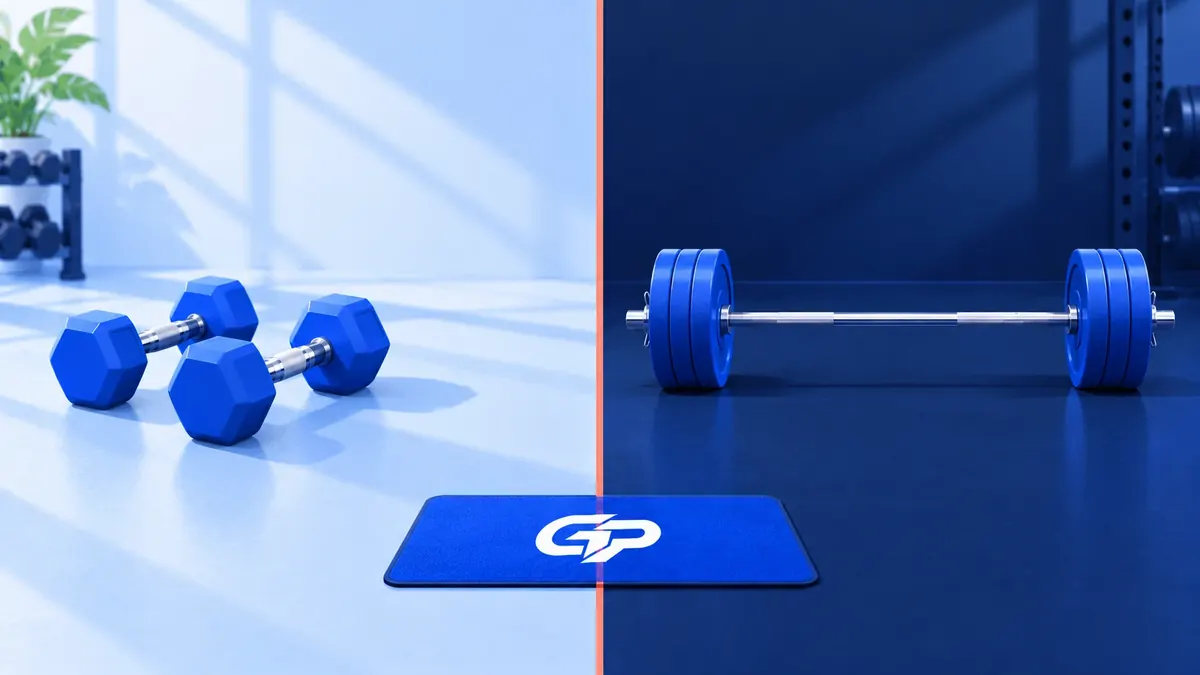
Barbell or dumbbells? The debate has no universal winner: each has its advantages. Understanding what each tool offers helps you build smarter training, rather than picking a side. Here is the comparison, movement by movement.
In this guideexpand_more
The barbell’s strengths
The barbell lets you load much heavier and easily track progress: adding 2.5 kg is simple and precise. It is the ideal tool for building maximal strength on the big lifts — squat, bench press, deadlift, row.
It is also more stable, which lets you focus on the push or pull without managing balance on each side. That is why the barbell remains the reference for heavy strength exercises.
The dumbbells’ strengths
Dumbbells offer a greater range of motion and let each arm work independently, which corrects left-right imbalances. They recruit the stabilizing muscles more and are often gentler on the joints, which choose their natural path.
They are also more versatile and accessible, especially at home. A simple pair of adjustable dumbbells lets you train the whole body, whereas a barbell needs more space and equipment.
The verdict: use both
There is no absolute winner. Most good programs combine both: the barbell for heavy strength on the basic lifts, dumbbells for development, balance and joint health.
Your choice also depends on context: at home with little space, dumbbells win; in the gym to build strength, the barbell rules. The ideal is not to deprive yourself of either, and most long-term progress comes from knowing when to reach for which tool rather than committing permanently to one over the other.
In practice, exercise by exercise
On the bench press, the barbell lets you load heavy for strength, while dumbbells offer greater range and stretch, often gentler on the shoulders. For heavy leg work (squat, deadlift), the barbell is unbeatable; for curls, raises or unilateral work, dumbbells feel more natural.
A good approach: keep the barbell for the big strength movements early in the session, then switch to dumbbells for development, left-right balance and joint comfort. That way you get the best of each tool without having to pick a side.
What about guided machines?
Guided machines (leg press, chest press, seated press) form a third family of tools, often underrated. They follow a fixed path, which removes the stabilization work but lets you focus entirely on the targeted muscle, particularly late in a session when technique starts to break down.
They are also valuable for beginners learning to feel a muscle working before moving to free-weight movements, and for isolating a specific muscle group at the end of a program. They do not replace the barbell and dumbbells on the basic lifts, but usefully complement them.
Building a home gym corner
To train at home on a limited budget and in limited space, a pair of adjustable dumbbells (or a set of plates with a short bar) covers most needs: they take up little room, store easily and let you train the whole body.
An Olympic barbell with plates needs more space (rack, bench) and a bigger investment, but becomes worthwhile if the main goal is building strength on basic lifts like the squat or deadlift. For most home trainees, starting with adjustable dumbbells and adding a barbell later if needed remains the most sensible choice.
Frequently asked questions
Do you absolutely need an Olympic barbell to build strength?expand_more
No, it is not mandatory. A short bar with plates, or even simple adjustable dumbbells, let you progress considerably in strength for years, especially as a beginner or intermediate. The Olympic barbell mainly becomes worthwhile at an advanced level, once the loads needed exceed what dumbbells can reasonably offer, or to specifically train competition lifts (squat, bench press, deadlift, snatch, clean and jerk).
Are dumbbells riskier than the barbell for joints?expand_more
It is usually the opposite: dumbbells let each hand follow a natural, independent path, which often reduces strain on the shoulders and wrists compared to a barbell that forces a fixed, symmetrical track. The barbell remains very safe when technique is correct and loading is progressive — the risk almost always comes from poor movement or badly managed load, not from the tool itself.
Are guided machines less effective than free weights?expand_more
No, they are not less effective, they play a different role: less stabilization work, but more precise muscle targeting. Combining them with free weights, rather than picking a side, often gives the best results over time.
What initial investment to equip a home gym?expand_more
A pair of adjustable dumbbells remains the best space/versatility/price ratio to get started, often for a modest budget. A full Olympic barbell setup with rack and bench costs more and needs more space, but becomes worthwhile if strength on the basic lifts becomes your priority.
Can you build muscle with dumbbells only?expand_more
Yes, absolutely, especially with adjustable dumbbells that go heavy enough. Their versatility covers all essential movements — presses, rows, squats, deadlift variations — for the whole body. Very advanced lifters may eventually need heavier loads than dumbbells alone can offer, but that is months, sometimes years, of progress away for most people, so it should rarely be a concern when starting out.
Is the barbell mandatory to progress?expand_more
No. The barbell is excellent for heavy strength, but you can progress enormously without it. What matters is progressive overload, whatever the tool — adding reps, sets or load over time is what drives adaptation, not the specific piece of equipment used to apply it. Choose what is available and what you can load safely, and build your progression around that.
Can you load as heavy with dumbbells as with a barbell?expand_more
The total load is often a bit lower with dumbbells, since you must stabilize two independent weights and gym dumbbells sometimes cap out. But the greater range and arm-by-arm work more than make up for it: at a slightly lower load, the stimulus stays excellent.
Put this guide into practice
Generate a program matched to your level, log your workouts and track your progress — for free.