
Squat or leg press: which to choose?
5 min read
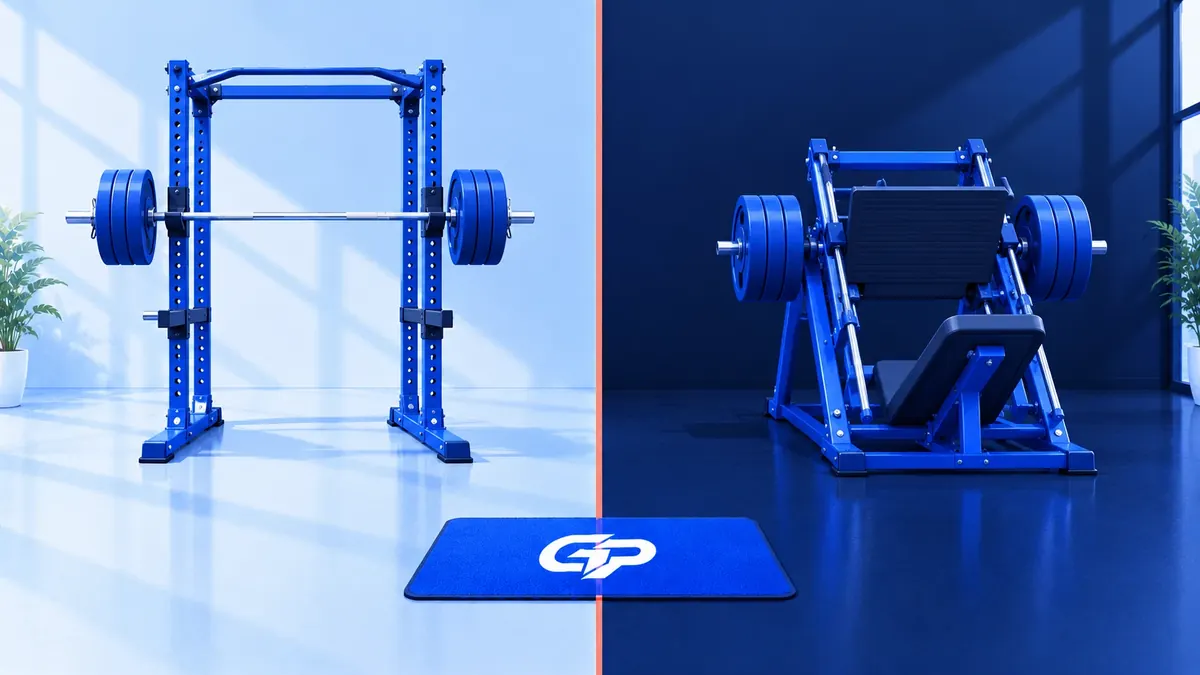
The squat and the leg press are the two great leg-building exercises. They are often pitted against each other, but they serve slightly different needs. Understanding their respective strengths helps you choose — or combine — intelligently.
In this guideexpand_more
The squat: the complete movement
The squat works not only the legs but also the trunk, back and core, which stabilize the load. It is a complete movement that builds functional strength and bracing useful everywhere else.
Its downside: it requires technique, mobility and good bracing. Poorly executed or overloaded, it can be intimidating. But well mastered, it is one of the most rewarding exercises there is.
The leg press: targeting the legs safely
The leg press guides the movement and removes the strain on the back and trunk. It lets you load heavy and target quads and glutes without worrying about balance — ideal for pushing a muscle close to failure safely, or when the squat bothers your back.
Its limit: it recruits stabilizers less and builds less transferable strength. The fixed path also does not suit every body type, and you must avoid rounding the lower back by going too deep.
How to choose
If you had to keep just one exercise, the squat wins for its completeness. But the leg press is an excellent complement: place the squat early for strength, then the press to add leg volume safely.
If the squat bothers you (back, mobility, apprehension), the leg press and lunges deliver excellent results. What matters is loading the legs through a full range, with the tool that suits you.
Don’t forget the back of the legs
Both the squat and the leg press are 'quad-dominant' movements: they mainly build the front of the thigh and the glutes, but recruit the hamstrings little. Relying on either one alone leaves the back of the thigh behind, which unbalances the leg and can weaken the knee.
For complete legs, add a hip-hinge movement (Romanian deadlift) or a leg curl for the hamstrings, and possibly a hip thrust for the glutes. The 'squat or leg press' debate ultimately only concerns the front half of the leg.
Volume and frequency: how many sets?
To progress on the legs, aim for 10 to 20 weekly sets split between squat, leg press and accessories, depending on your level and recovery. The squat, more demanding on the nervous system, suits 2-3 sessions per week with varied loads; the leg press, less taxing on the nervous system, can be pushed closer to failure more often without wearing you out as much.
An effective pattern is to place the squat early in the session at moderate to high intensity, then finish with several sets of leg press to add volume without compromising squat technique in later sessions.
The leg press as a rehab and return-to-training tool
After a back injury or when returning to training, the leg press often lets you keep loading the legs without the bracing and balance demands of the squat. It is an excellent bridge to maintain muscle mass while the back recovers.
Once confidence returns, reintroduce the squat gradually, starting light and working on technique first before adding load. The leg press then remains a useful complement rather than a permanent substitute.
Frequently asked questions
Does the leg press replace the squat?expand_more
It can replace it for leg development, especially if the squat gives you trouble. But it does not reproduce the trunk and stabilizer work. Ideally, combine both; otherwise, the leg press and lunges are enough to build the legs.
Is the leg press safer than the squat?expand_more
It removes the strain on the back and balance, making it more accessible to push heavy without a spotter. But it carries its own risks if you go too deep and round the back. No exercise is dangerous in itself: it is load and technique that matter.
Are the squat and leg press enough for complete legs?expand_more
They build the quads and glutes very well, but the hamstrings little. For balanced legs and a solid knee, add a dedicated movement for the back of the thigh, such as the Romanian deadlift or the leg curl.
Does the front squat change the comparison?expand_more
The front squat recruits the quads and upper back more, with less load on the lower back than the back squat. It sits between the back squat and the leg press in technical demand, and can be a good alternative if the back squat bothers you.
Can you do leg press every day?expand_more
It is neither necessary nor optimal: muscles need 48 to 72 hours to recover after an intense set. Two to three leg sessions per week, alternating squat and leg press, are more than enough to progress.
Does the bodyweight squat prepare you for the loaded squat?expand_more
Yes, it is an excellent base for learning the movement mechanics (depth, back position, breathing) before adding a bar. Mastering the bodyweight squat reduces technique errors once load is added.
Should you always go very deep on the squat and leg press?expand_more
A full range of motion (thighs parallel to the floor or lower) maximizes muscle development, as long as mobility and the back allow it without pain. If that is not yet the case, work on range gradually rather than forcing an uncomfortable depth.
Can the leg press replace lunges for leg variety?expand_more
Partially: the leg press mainly targets the quads and glutes bilaterally, while lunges add useful unilateral work for balance and stability. The two complement each other rather than fully replacing one another.
Is the goblet squat a good starting point?expand_more
Yes, holding a dumbbell against your chest (goblet squat) helps keep your torso upright and learn the squat mechanics safely, before moving to the barbell. It is an excellent bridge between the bodyweight squat and the loaded barbell squat.
Is the leg press enough if the squat hurts my knee?expand_more
In many cases, yes: adjust your foot position on the platform (higher, wider) to reduce knee flexion, and limit depth if needed. If pain persists, consult a health professional before continuing to load the movement.
Put this guide into practice
Generate a program matched to your level, log your workouts and track your progress — for free.