
Machines or free weights: which to choose?
5 min read
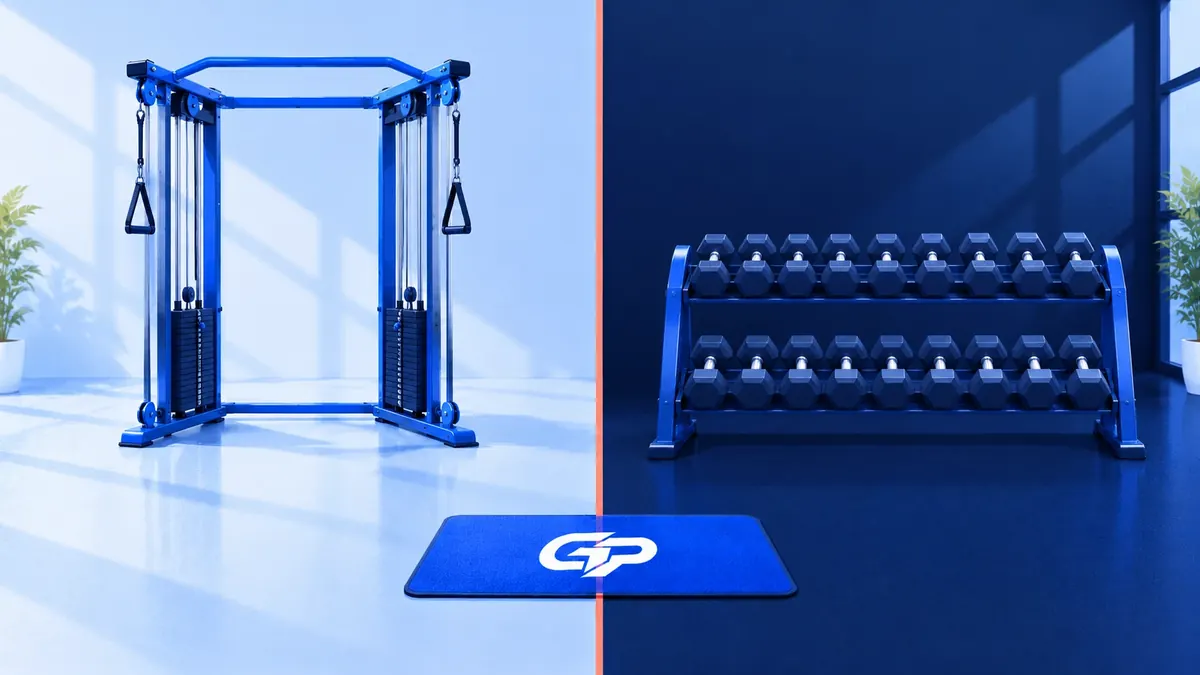
Should you favor machines or free weights (barbells and dumbbells)? Many pit the two against each other, when they are mostly complementary. Each has its strengths depending on your level, goal and context. Here is how to place them.
In this guideexpand_more
What free weights offer
Free weights recruit many stabilizing muscles and build useful strength that transfers to daily life. They offer total freedom of movement and allow the big compound exercises, the most effective for building strength and muscle.
In return, they demand more technique and learning. It is an investment that pays off, but requires patience at first.
What machines offer
Machines guide the movement, making them easier to learn and often safer for isolating a muscle without worrying about balance. They are valuable for targeting a specific muscle, for beginners, or for continuing a set at the end of a session when fatigue makes free weights risky.
They also let you push a muscle close to failure safely, without a spotter. Their limit: they recruit stabilizers less and impose a fixed path that does not suit every body type.
The best of both worlds
The smart answer is not to choose, but to combine. Build your session around free weights for strength and overall development, then use machines for isolation, end-of-session safety and extra volume.
As a beginner, you can lean more on machines to learn with confidence, then gradually bring in free weights. What matters is progressing, whatever the tool.
Cables: the best of both?
Between guided machines and free weights, the cable sits in a class of its own. It combines a free path (you choose the movement angle) with constant tension that never lets off, even at the bottom. It is ideal for isolating a muscle under continuous tension, where a dumbbell loses its load at the bottom.
Lateral raises, flyes, rows, triceps extensions: many isolation exercises benefit from being done on the cable. See it as a third tool, complementary to free weights and machines, rather than a competitor.
Safety: the role of a spotter
On big free-weight lifts (bench press, squat), a heavy load taken close to failure can pin you down without a spotter or safety pins in a rack. Machines remove that risk: if you fail a rep, you simply rack the load without it crushing you. That is a real advantage for training alone, late in the day or in a quiet gym.
This does not mean free weights are dangerous: with a squat rack, safety pins, or by leaving a rep or two in reserve, the risk stays minimal. But if you often train alone without safety equipment, favoring machines for your closest-to-failure sets is a pragmatic choice.
After an injury or joint discomfort
After an injury or with joint discomfort, machines are often the first choice for returning to training: the guided path limits compensations and lets you target a muscle precisely without stressing the sensitive joint in unstable positions.
Once confidence and mobility return, gradually reintroducing free weights restores the functional strength and stabilizer work that a machine cannot replicate. In both cases, progress in stages and do not hesitate to seek advice from a health professional if the discomfort persists.
Frequently asked questions
Are machines less effective than free weights?expand_more
For pure muscle building, both work very well if the effort is sufficient. Free weights have the edge for functional strength and big movements; machines excel at isolating and providing safety. Combining both is optimal.
Can a beginner use only machines?expand_more
Yes, it is a good starting point to learn safely and with confidence. But gradually adding some free weights (squat, press, row) speeds up progress and builds more complete strength. Aim to combine both over time.
Does the cable count as a machine or a free weight?expand_more
A bit of both: the path is free like a free weight, but the resistance comes from a constant-tension machine. That combination makes it an excellent isolation tool, complementary to barbells, dumbbells and guided machines.
Are machines suitable for women or older adults?expand_more
Yes, just as much as for anyone else: machines are not reserved for a particular profile. They let you learn the movement safely, whatever your age or level, before adding free weights if you wish.
How long should you stay on machines only before free weights?expand_more
There is no fixed duration: a few weeks to a few months depending on your progress and confidence. Once you master the basic mechanics (bodyweight squat, proper bracing), you can introduce a light bar and progress gradually.
Do guided machines give the same gains as free weights?expand_more
For pure hypertrophy, yes, at equivalent volume and intensity. The difference mainly shows up in functional strength and stabilizer recruitment, where free weights keep a slight edge.
Should you avoid free weights if you don’t have a gym?expand_more
No: at home, adjustable dumbbells or a few free weights are enough to progress effectively — see our 'Home strength training' guide. Machines remain mainly an advantage specific to equipped gyms.
Are guided machines suitable for bulking?expand_more
Yes, they let you accumulate training volume safely, which is precisely one of the drivers of muscle gain. Combined with compound free-weight movements, they cover the needs of a bulking program very well, especially late in a session.
Can you mix machines and free weights in the same session?expand_more
Yes, and it is even recommended: generally place compound free-weight movements early in the session, when you are freshest, then finish with machines to isolate and fatigue the targeted muscles safely.
Are free weights more effective for losing fat?expand_more
Not directly: fat loss depends above all on your diet. That said, compound free-weight movements recruit more muscle and can slightly raise energy expenditure per session, which remains a secondary bonus compared with what you eat. Machines can raise that expenditure too, especially in a circuit format that keeps rest periods short.
Put this guide into practice
Generate a program matched to your level, log your workouts and track your progress — for free.